
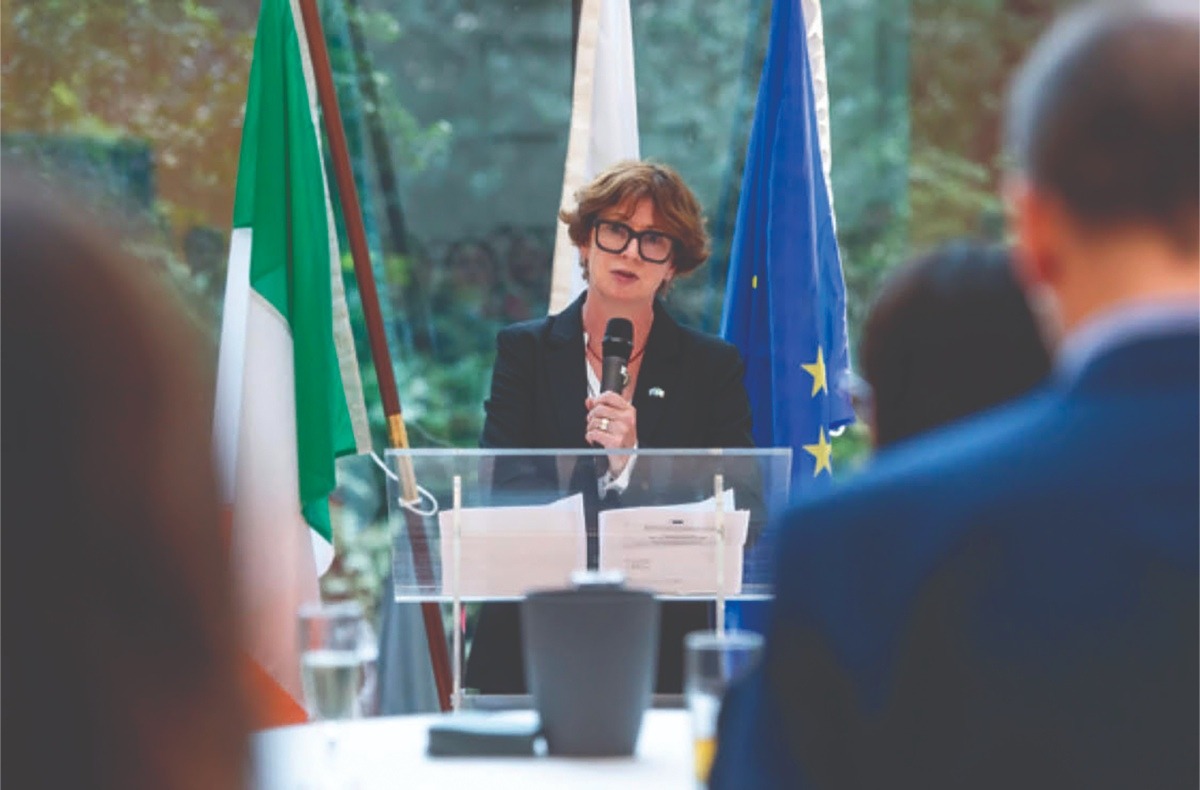
Patricia (Trish) Reilly is a UCD veterinary graduate (MVB 1996) who has enjoyed an eclectic career, marrying her love of animal health with a strong interest in politics and law. Currently European Commission President Ursula von der Leyen’s advisor on agriculture, health, animal health and welfare, equality and financial services, she reflects on her time in UCD and how it set her on the path to her demanding, yet fulfilling job.
The scientific method is something that I bring to my work every day.”
How did your UCD experience set you on the path to the career you have now?
I came from a veterinary background. My dad was a vet – he was sort of the classic James Herriot type, a country vet who wore a tweed jacket and a tie to work every day, even when he was calving cows. So I spent all of my childhood holidays in the car with him, driving around from one farm to the next while he did his calls.
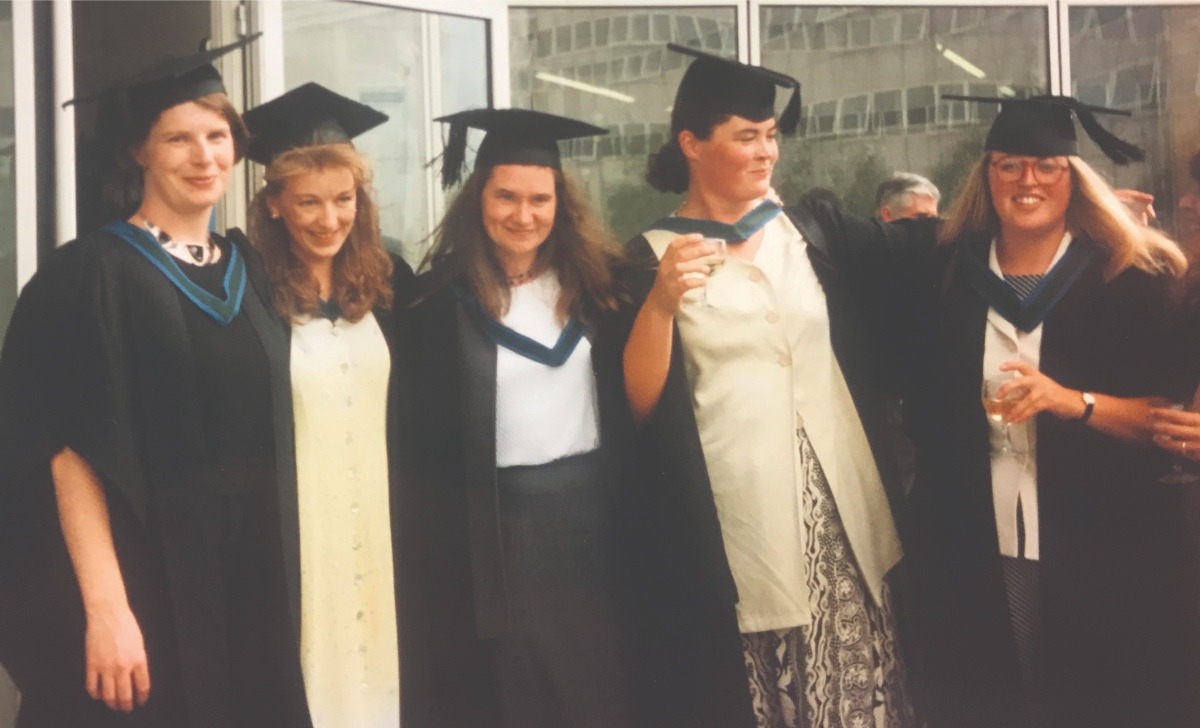
I took the scenic route through college. If I’m honest, I suppose I found the first few years difficult because I failed exams. And I think I failed the exams because I found the coursework difficult and boring. Full disclosure – I also partied quite a lot! But once I got as far as the final couple of years, I was really glad that I stuck with it.
It was back in the days when the Veterinary College was on Shelbourne Road in Ballsbridge, and we were in a little bubble. It was a great time, a really fantastic experience. I loved the Vet College and I really liked the people I was in class with, and also the staff.
When I left UCD I went into mixed general practice, and I loved it, but I knew after a while that it wasn’t for me long term, so I joined the Department of Agriculture, Food and the Marine in 2001, joining literally as foot and mouth disease broke out in the UK. It was all hands on deck, so I got an opportunity to experience a lot at an early stage.
I also very quickly realised I didn’t know the difference between a directive and a regulation, so I studied for a diploma in European law with the Law Society, which I found fascinating, and then went on to King’s Inns.
Looking back, is there anything from your early path you still draw on in your job today?
The honest to God answer is I use it every day of the week. I use it every hour of the day. The scientific method is something that I bring to my work every day. If something is put in front of me as a proposal or an idea, where’s the evidence to underpin it? Where does that come from? Is it credible? Can you back it up? Is there a better way to do it?
I also think veterinary medicine tends to attract people who are quite independent and capable of working on their own initiative; problem solvers. That scientific rigour is important, but so are the people skills. Whatever job you’re doing, you have to be able to work with the people around you.
You are on the external advisory committee for UCD School of Veterinary Medicine – do you still maintain strong links to the University?
I am a very proud UCD graduate, and I made precious, lifelong friendships with people who mean a great deal to me. I’ve watched the veterinary faculty move to the fabulous facility on the Belfield campus, taking its place among the best in Europe.
Ours is one of only nine European colleges accredited by the American Veterinary Medical Association, a measure of its international reputation. I’ve been lucky enough to work with Dr Tony Holohan, who leads UCD One Health Centre, and I look forward to further collaboration. One Health is a crucial approach, highlighting the interdependence of human health, animal health, and our environment – three legs of a stool that can only be stable if all the supports are robust.
How do you see UCD expertise contributing to shaping Europe’s future, given its success in Horizon Europe funded research, for example?
Ireland has really upped its game when it comes to research, and a big fuel to that came when I was working with Máire Geoghegan-Quinn. As European Commissioner for Research and Innovation, she put a focus on the value of the Horizon Programme to researchers and universities. UCD has really stepped up on that. It is incredible to see the work that’s going on. There are world leaders in certain sectors in UCD, especially the bioeconomy, where there’s fabulous work happening. We’ve got the One Health Centre with top-class people who are very highly regarded at an international level.
What does the EU presidency mean for Ireland and what can we hope to achieve?
The European budget is agreed every seven years, and we’re coming to a crucial point now. Hopefully, during the course of the Irish presidency, the overall budget for the coming seven years will be agreed. That means there’s a lot of responsibility on the presidency. Of course, from that will flow the funding for the next Horizon programme and the next Common Agricultural Policy. These policies are relevant and of great benefit to Ireland.
On a granular level, in my own policy areas, I hope we make serious progress on the Biotech Act, which I coordinated and steered the political proposals on, and which aims to speed up clinical trials in Europe and improve competitiveness.
Does Ireland have an influential role within the EU?
In terms of preparation for the Irish presidency, we’ve done a fantastic job. There’s a really good team of people with expertise, who were bedded down in their roles before the presidency started and who know the environment here well.
Within Europe, I don’t think we punch above our weight, but we box clever. We’re one of 27, and we are as influential as any other member state in that sense. It’s a remarkably democratic system. I know people complain sometimes about Brussels and bureaucracy and rules, but I can’t think of a better place to live than Europe, to be honest.
Are there specific events you are looking forward to as part of the presidency?
I’m very excited to see UCD Lyons Farm being showcased as part of the University’s Presidency programme. I have great memories of Lyons – it was a much less sophisticated place in the 1990s. We took a rickety bus from Ballsbridge every week to learn the fine arts of animal husbandry, which was probably the first element of the curriculum that involved live animals, and kept me interested in the course.
What would you say to a young person in Ireland today who wants a career shaping EU policy, but has no idea where to start?
A career that involves shaping EU policy is incredibly rewarding, whether working at national or EU level. For a career in one of the European institutions, get yourself a good primary degree, and don’t assume that your qualification has to involve European law or economics. Vets may be a bit of a rarity in the Commission, but I’m certainly not the only one, and I have colleagues who are physicists, doctors, humanities graduates and IT specialists.
To get started, the institutions offer great internships, or stages, where successful applicants get to spend five months in a paid position in one of the many policy departments. In very general terms, I would encourage any young person to keep their hearts and minds open to opportunity. I don’t really believe in making long-term career plans – what you think you want to do with your life may evolve; keep learning and don’t be afraid to pivot to something new.