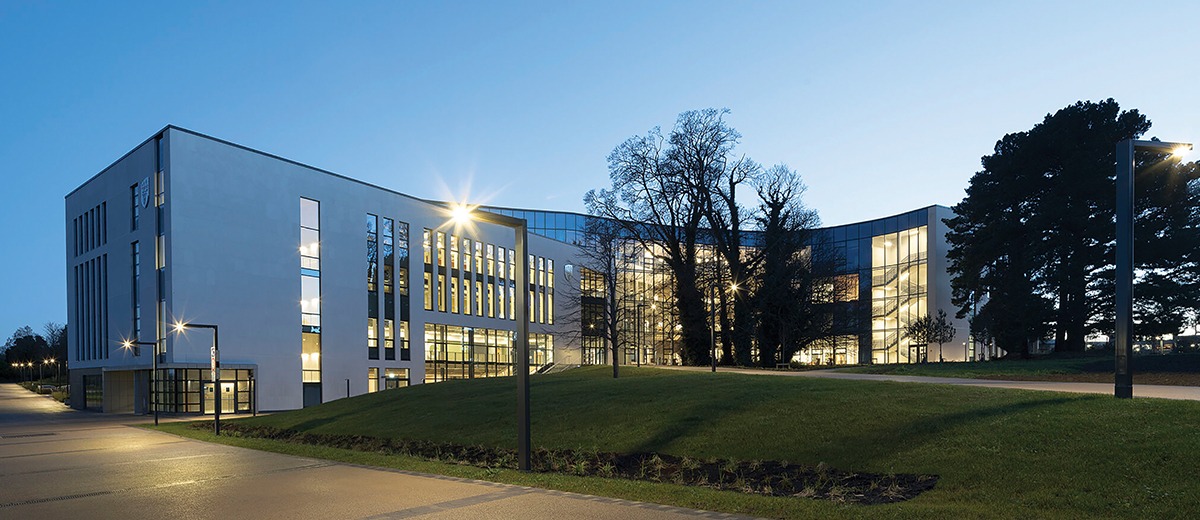
This year, UCD took its place among the world’s top 100 universities, ranking joint 100th globally in the latest QS World University Rankings. A leap of 18 places, it is confirmation of a sustained upward trajectory and puts UCD in the top 8% of the nearly 1,500 institutions ranked worldwide, with 13 subject areas ranked in the world’s top 100 and four of those within the top 50.
The University also holds a top-50 global position for sustainability and remains in the top 100 for graduate employment outcomes, further proof that a UCD education translates directly into real-world impact.
But rankings only tell part of the story. The measure of a university is found in the people it sends out into the world, and the impact they have. UCD graduates are playing a significant role in moments of change, and today, amid rapid technological shifts, global challenges and evolving communities, that matters more than ever.
Our future is being shaped by alumni working at the frontiers of industries including biotechnology, quantum computing, pharmaceuticals, education and film. Here, five trailblazing graduates share what their time at UCD gave them, and how it set them on the path to the work they do now.
From bootstrapping a company that would help pioneer synthetic biology, to building tools that could redefine computing, to reaching thousands of students across the globe, their stories share a common thread: an education that didn’t just prepare them for a career, but equipped them to shape the future itself.

AGHOGHO OKPARA
Achieve With Aghogho is closing the gap between potential and opportunity for the next generation by turning its founder’s own story into a global case for educational equity. Recognised in the Forbes 30 Under 30 Europe 2026 list, Dr Aghogho Okpara has also been named a “Face of the Future” by the Irish Times.
The impact I want to make is to advance equality of opportunity globally.”
“Achieve with Aghogho is an educational equity organisation that helps students to believe in themselves and equips them with the skills and resources they need to succeed in their career. We run monthly workshops teaching skills like communication, study, or work-life related issues.
“So many young people don’t have the tools they need to get from where they are to where they want to be. We’re working to provide them with this, so that they can succeed, and Achieve with Aghogho has reached over 5,000 young people across 45 countries in the past year and a half. The thing our members talk about most is that we are connecting them to other young people with similar interests. It has been great to introduce participants to like-minded people with similar goals.
“I really enjoyed my time in UCD, where I studied medicine, mainly because of the people I met there. Many of the classmates I had were supportive of my journey, and some of the professors I met were instrumental in my journey as well. It wasn’t just with medicine but also with my life in general, helping me to understand how to interpret my various interests and what to do with them.
“For me, the impact I want to make is to advance equality of opportunity globally, so that everybody who has potential has access to the resources they need.”
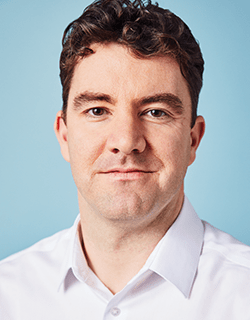
DR BARRY CANTON
Ginkgo Bioworks’ mission is to make biology easier to engineer. Dr Barry Canton is one of five founders of the US biotech company. Cell programming, where DNA code is edited to give cells new jobs, and robot labs, which use automation to run large-scale biological experiments, are just two things that make it different.
The freedom to experiment in academia is precious and it should be celebrated.”
“Bringing an engineering approach to problems is probably the most impactful thing I took from my time at UCD. Getting that opportunity to do research so early was important for me, and at Ginkgo Bioworks, our mission is to make it easier to engineer biology.
“I started the company with four others and we bootstrapped it for a number of years, until we built up a small business. Then in 2014, we did the Y Combinator programme. We were the first biotech company to do that, and it was Sam Altman (now of OpenAI) who recruited us into it. Increasingly, we were able to win commercial contracts and all that culminated in Ginkgo going public in 2021.
“Getting to UCD and meeting a bunch of people who were also interested in science and engineering was, by itself, a big milestone for me. Professor Michael Gilchrist approached me at the end of my third year about doing undergraduate research. That was my first exposure to undergraduate research, and I discovered that I really enjoyed it. It set me on a path – I got exposure to biology, and I made a turn in my career from mechanical engineering to biological engineering.
“Into the future, universities will continue to be important for groundbreaking research that companies get to build on. The freedom to experiment in academia is precious and it should be celebrated: it enables lots of people to do exciting things.”
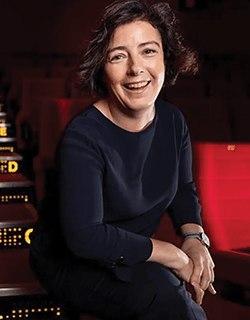
GRÁINNE HUMPHREYS
Film is personal to Gráinne Humphreys, Executive Festival Director of the Dublin International Film Festival (DIFF). Gráinne volunteered at the original Dublin Film Festival in the 1980s, and now champions homegrown Irish film at DIFF with the same weight as major international premieres.
We try to find ways of connecting with filmmakers earlier in their careers, so we can help them to build and sustain a career.”
“I went to UCD basically as an alternative to a journalism degree in Manchester Polytechnic because my understanding was that to be a film critic, you needed to understand something about the arts.
“Effectively, what I actually came out with was a network and a portal into film programming that I’ve never left. In my first year, I joined the Film Society and I also joined the committee. About six months after I graduated, I got my first job running a film festival. UCD gave me an insight into the world of research, preparation and presenting films, which I still do now.
“Next year, the Dublin International Film Festival will be 25 years old. The great thing is that Irish cinema has done quite well in that time and the Festival has grown in parallel with that. I remember when we showed An Cailín Ciúin in 2022, there were floods of tears at the screening. I thought it was because it was an amazing film that hits everyone. Then it kept happening at other films, no matter what genre it was, and it was because people were so happy to be back out seeing films after the pandemic.
“I’ve had so many highlights over the years. Interviewing Al Pacino was quite cool, and he was so nervous about bringing a film about Oscar Wilde – Wilde Salomé – to Dublin. I was stunned that the actor who had played Michael Corleone would be worried about what an Irish audience would think about his film. As I keep telling filmmakers, without them, I don’t have a job.
“Looking to the future, we try to find ways of connecting with filmmakers earlier in their careers, so we can help them to build and sustain a career.”
DR JOE FITZSIMONS
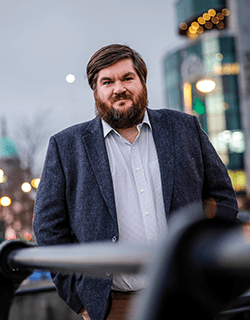
Only a few hundred specialists worldwide can currently formulate quantum algorithms. Joe Fitzsimons’ Horizon Quantum Computing aims to change that by making quantum programming accessible to any developer. In 2025, it became the first quantum software company to own and operate its own quantum computer.
My core motivation has always been a desire to create new technology that has an impact in the real world.”
“I studied theoretical physics at UCD, and one of the unique things about the programme was that you could take computer science in first year as an optional course. In fourth year, I had an option to take a course in quantum computing. That was my first exposure to it, and it would have been a very early course in the area.
“Quantum computing is really at that interface between computer science and physics, and looking back now, the programme turned out to be very good preparation for my career in the field.
“I have spent much of my career in academic research, but my core motivation has always been a desire to create new technology that has an impact in the real world. As quantum computing moved out of the lab and into industry, I decided to make the leap and leave academia to start a company myself, Horizon Quantum.
“Much of my research career was spent working on developing new quantum algorithms and protocols, but Horizon is trying to do something different: to build software development tools to make quantum programming more accessible. We’re ultimately trying to get to the point where we can take code written for conventional computers and automatically accelerate it with quantum computers.
“To make that possible, we have been developing the mathematical techniques and programming tools that underpin our approach. We are now operating quantum hardware ourselves, creating a testbed where we can integrate our software directly with the machines’ control systems. Our first system is at our Singapore headquarters, but we plan to establish a new testbed in Dublin soon with a more advanced quantum computer.”
DR MARGARET FAUL
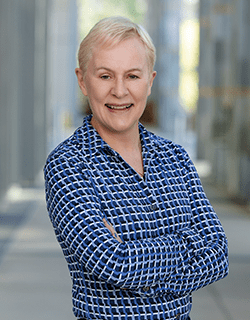
Amgen is a biotechnology innovator, not just a medicine-maker. Dr Margaret Faul is looking to make those innovations greener and more sustainable as the company unlocks the potential of biology for patients suffering from serious illness, through tools such as advanced human genetics.
I’m working to influence the industry-wide approaches we take as we develop pharmaceuticals.”
“I had a great experience at UCD. I was focused on science, doing chemistry, biochemistry, pharmacology and more. I did a lot of lab work and I really enjoyed it because the professors were excellent. They gave me a really solid foundation and I was in a class with a great group of students. It set the foundation for what I have done since.
“When I left Ireland in 1987, I went to Harvard, which was a very different experience. I spent five years there and then I went to Eli Lilly for just over 10 years. That really was where I learned process chemistry, and I was able to grow and develop my experience there.
“I’ve met a lot of people through work, and I have continued to build my network. Now, I’ve been at Amgen for 23 years, and I have moved across a lot of parts of the organisation. I’ve been able to contribute to almost every commercial molecule that Amgen has launched, in addition to having a significant impact on the work they are doing in commercial development.
“As we develop those processes, our focus is increasingly on sustainability. We are looking to reduce the impact they have on the environment by making them greener. I’m working to influence the industry-wide approaches we take as we develop pharmaceuticals.”